top of page

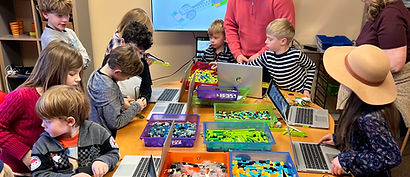

AI journey for kids
AI Journey. Kids will explore the fascinating world of artificial intelligence and how smart machines learn and make decisions. They’ll get a sneak peek into concepts like pattern recognition, training data, and how AI can understand images and classify information. Students will also discover conversational AI, including chatbots and voice commands, and have the opportunity to create their own AI-powered games. Through these activities, they’ll develop problem-solving, logical thinking, and creativity while learning how AI impacts the world around them.

Best Value
Fall 2026 Evening STEM Weekly Challenges
$179
179
Every month
(FULL SEMESTER: 4 Month commitment. 4 payments) Weekly STEM challenge (or Chess club)+Arena Free play+Friday Real world skills
Valid for 4 months
Choose your pricing plan
* For more information about packages and membership please visit our Pricing page
Course outline
Class name | Class Description | Class objectives | Key takeaways |
|---|---|---|---|
Create your game with AI | In this hands-on class, students will combine creativity and technology to design their own games using AI tools. Kids will learn how AI can help with characters, challenges, and game logic, and they will build a playable game by the end of the session. The class emphasizes problem-solving, creativity, and responsible AI use. | "Explain how AI can assist in game creation.
Design simple game rules, characters, and goals.
Use AI tools to enhance game logic or visuals.
Test and improve their game based on feedback.
Understand safe and responsible use of AI in games." | "AI can help automate game logic, create characters, and recognize patterns.
Clear instructions and rules make AI-assisted games work better.
Game design combines creativity, problem-solving, and testing.
Iterating and improving is part of creating a successful game.
Responsible use of AI ensures safe and fun gameplay." |
Conversational AI – Chatbots & Commands | In this class, students will explore how AI can communicate through chatbots and voice commands. Through interactive games and demonstrations, kids will learn how chatbots follow rules, respond to questions, and understand commands. They will also discover the difference between simple rule-based chatbots and smart AI chatbots, and how to use them safely. | "Explain what a chatbot is and how it works.
Understand the difference between rule-based and AI-powered chatbots.
Demonstrate how to give clear commands to a chatbot.
Recognize common uses of chatbots in games, apps, and websites.
Practice safe interactions with chatbots and other conversational AI." | "Chatbots are AI programs that respond to text or voice messages.
Rule-based chatbots follow strict instructions; AI chatbots can learn patterns.
Clear instructions make chatbots work better.
Chatbots are used for games, customer service, learning apps, and more.
Always use chatbots safely and avoid sharing personal information." |
Image Recognition & Classification | In this class, students will learn how AI “sees” the world by recognizing and classifying images. Through hands-on activities and interactive demos, kids will explore how machines identify objects, animals, and other items in pictures. They will also understand why AI sometimes makes mistakes and how more examples can improve accuracy. | "Explain what image recognition is and why it is important for AI.
Understand how AI classifies objects in images.
Identify real-life applications of image recognition (e.g., photo tagging, self-driving cars).
Recognize that AI can make mistakes when images are unclear or confusing.
Experiment with training an AI to classify simple objects using examples." | "AI “looks” at images by analyzing patterns and features.
Classification is how AI decides what an object is.
The more examples AI sees, the better it can recognize objects.
AI is not perfect; it can make mistakes if images are unclear.
Image recognition is used in games, apps, cameras, and many other technologies." |
How AI Learns – Examples, Patterns & Training | In this class, students will discover how AI learns by studying examples and recognizing patterns. Through hands-on activities and games, kids will see how smart machines improve over time and why good examples are important. The class emphasizes understanding AI’s learning process in a simple, engaging way and encourages curiosity about technology. | "Explain that AI learns by looking at examples and finding patterns.
Understand that the quality and quantity of examples affect AI’s learning.
Identify everyday situations where AI uses patterns (e.g., recommendations, image recognition).
Recognize that AI can make mistakes if examples are confusing or wrong.
Practice creating simple examples to “train” a machine." | "AI learns from examples, not like humans.
Patterns help AI make predictions or decisions.
More and better examples = smarter AI.
AI can make mistakes if trained with wrong or unclear examples.
Learning is an ongoing process—AI improves with experience." |
What Is AI? – Understanding Smart Machines | In this class, students will explore the exciting world of Artificial Intelligence (AI) and learn how smart machines help us in everyday life. Through fun demonstrations, games, and discussions, kids will understand what AI is, what it can do, and why it’s different from humans. By the end of the session, students will be able to recognize AI in action and understand its role in technology and daily life. | "Explain in simple terms what AI is and how it works.
Identify examples of AI in everyday life (smart assistants, games, recommendations).
Understand the difference between AI and human intelligence.
Recognize that AI follows rules and learns from examples.
Develop curiosity about how smart machines can help solve problems." | "AI is a tool that helps computers “learn” from data and examples.
AI is not human; it can’t feel, think, or make decisions like people.
Smart machines are everywhere: in games, apps, and devices.
AI learns by recognizing patterns, improving over time with examples.
Understanding AI helps us use technology safely and creatively." |
bottom of page